The churches
Saint-Sulpice: the organ, the Delacroix chapel and the noon line
The second largest church in Paris, its Cavaillé-Coll organ with 102 stops, Delacroix's murals and the brass line that tracks the sun.
Choose a date ↗Quick answer
Saint-Sulpice is the second largest church in Paris, begun in 1646. It holds a great organ rebuilt by Cavaillé-Coll with 102 stops on five manuals, murals by Eugène Delacroix in the Chapel of the Holy Angels, and a brass meridian line, or gnomon, laid out in the 18th century. It is the concert's third setting.
The second largest church in Paris
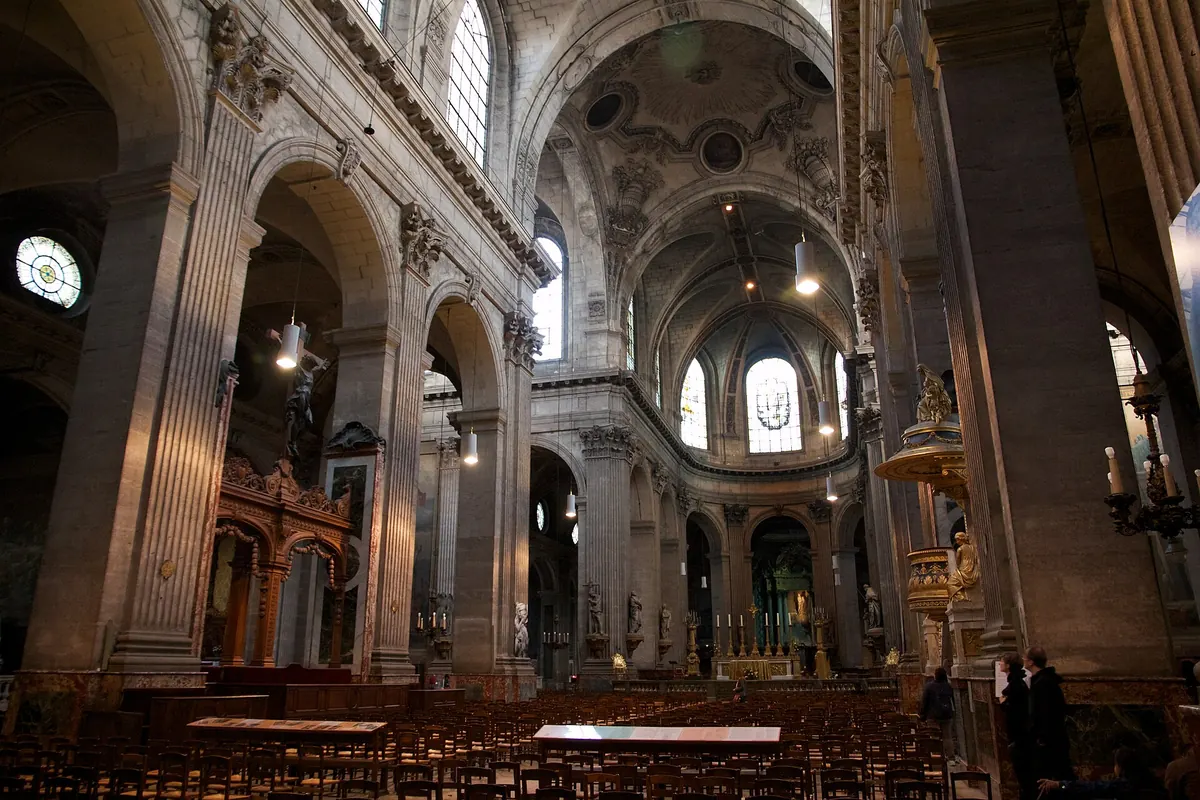
Wikipedia calls Saint-Sulpice the second largest church in the city, in the 6th arrondissement. Building began in 1646 under the parish priest Jean-Jacques Olier, and Daniel Gittard supplied the general design in 1660. Work continued through the 18th century and, according to the infobox, was completed in 1870. Only the north tower was rebuilt, by Jean-François Chalgrin between 1777 and 1780; the south tower was never replaced.
The great organ
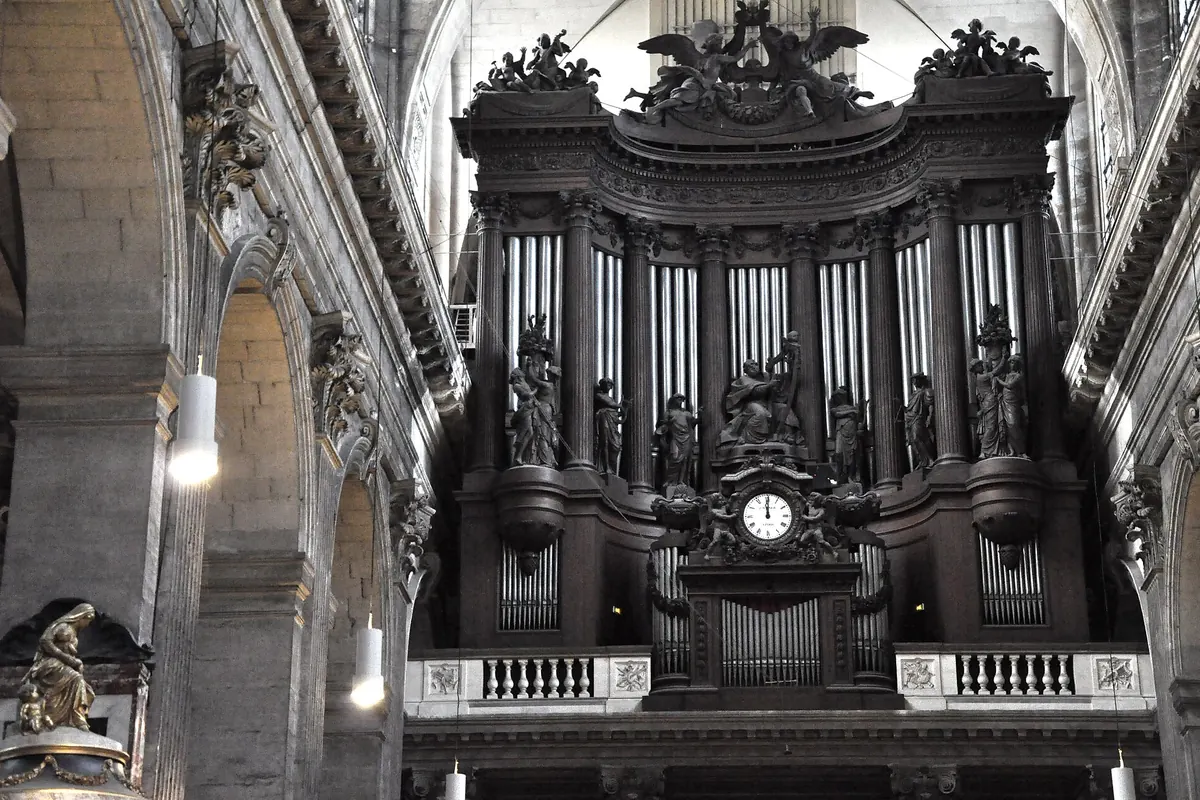
The City of Paris says François-Henri Clicquot built the earlier organ, inaugurated in 1781, and that Aristide Cavaillé-Coll built the current instrument, inaugurated in 1862, keeping Clicquot's pipes, about 40% of the new total. It has 102 stops on five manuals and about 7,000 pipes, and the city calls it the largest organ Cavaillé-Coll built. The case and the instrument are listed as historic monuments.
The people at the keyboard
One organisation that promotes the organs says Charles-Marie Widor became organist in 1870 at the age of 26, as a temporary organist, and held the post for 63 years without ever receiving the formal title of titular. Marcel Dupré succeeded him and served until his death in 1971. The City of Paris names Daniel Roth as titular organist from 1985.
Delacroix's chapel
Wikipedia says Eugène Delacroix painted the murals between 1855 and 1861 in the Chapel of the Holy Angels, the first side chapel on the right. The wall paintings are Jacob Wrestling with the Angel and Heliodorus Driven from the Temple, and the ceiling painting shows the archangel overcoming the demon. A concert ticket does not include a tour, so any visit to the chapel is something to arrange within the church's opening times.
The noon line
Wikipedia says the priest Jean-Baptiste Languet de Gergy requested a gnomon in 1727 to help determine the equinoxes and the date of Easter, and that Henry Sully built it. The marble obelisk is dated 1743 and is nearly eleven metres high. A ray of light from an opening in the south transept reaches the brass line on the obelisk at noon on the winter solstice.
After the novel
Wikipedia notes that Dan Brown's 2003 novel drew many tourists to the church, and that the church displayed a note disputing the novel's claims, including that the floor line is a pagan temple vestige. It also records that in 2005 the Archdiocese of Paris refused Ron Howard permission to film inside. The line is a scientific instrument, not a hidden code, and the church says so.
The concert here
Saint-Sulpice is one of three settings on the booking page, assigned by date. The room is big and stone, so the sound will bloom, as Wikipedia's article on reverberation suggests for large churches. Start times differ by church, so read your confirmation. Plan to arrive about 30 minutes early.
Who this isn't for
Anyone hoping to hear the great organ itself should remember that the booking page describes an orchestra, not an organ recital. If you want to see the Delacroix murals, treat that as a separate visit. And if you prefer a small room, the scale here is not for you.
Read next: Are the classical concerts in Paris churches worth it?
Frequently asked questions
How big is Saint-Sulpice?
Wikipedia calls it the second largest church in Paris.
Is the organ part of the concert?
The booking page describes an orchestra; it does not say the organ is played.
Sources