The churches
La Madeleine: a Greek-style temple that became a church
How a church planned under Louis XV became a temple to Napoleon's army, then a church again, and what its colonnade and domes mean for a concert.
Choose a date ↗Quick answer
La Madeleine is a neoclassical building in the style of a Greek temple, ringed by Corinthian columns. Its first stone was laid in 1763, Napoleon turned it into a temple to his army in 1806, and it was inaugurated as a church in 1842. Inside is a single long space under three domes with skylights, with no transept. It is the concert's second setting.
From Louis XV to Napoleon
Wikipedia says Louis XV planned the church and that Pierre Contant d'Ivry and Guillaume-Martin Couture designed it, with the first stone laid in 1763. The Revolution halted work in 1789. In 1806 Napoleon declared the building a temple to his army, and Pierre-Alexandre Vignon took over the design. Work resumed on a church after 1814, and Jacques-Marie Huvé succeeded Vignon, who died in 1828.
A temple with columns on four sides
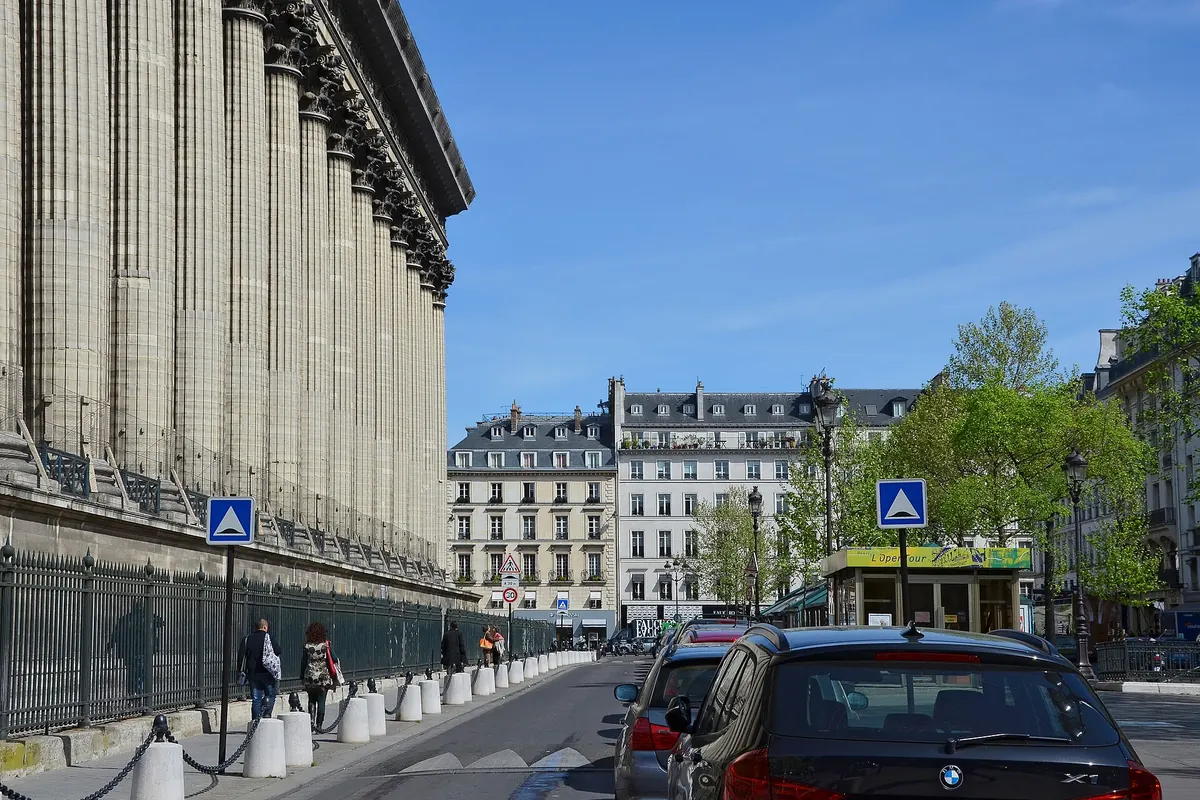
The result is a Neoclassical building modelled on a peripteral Greek temple. Wikipedia says its fifty-two Corinthian columns, each 20 metres high, surround the building. Walking along the side, as in the photograph, you see the colonnade run the length of the church.
Inaugurated in 1842
The building was inaugurated as a church on 24 July 1842, says Wikipedia, which also notes that a different date, 1828, appears in the infobox but that the text says it was not completed until 1842. The seventy-nine years between the first stone and the inauguration are a reminder of how often politics decided what was built in Paris. It stands in the 8th arrondissement, says the booking page.
Domes and skylights
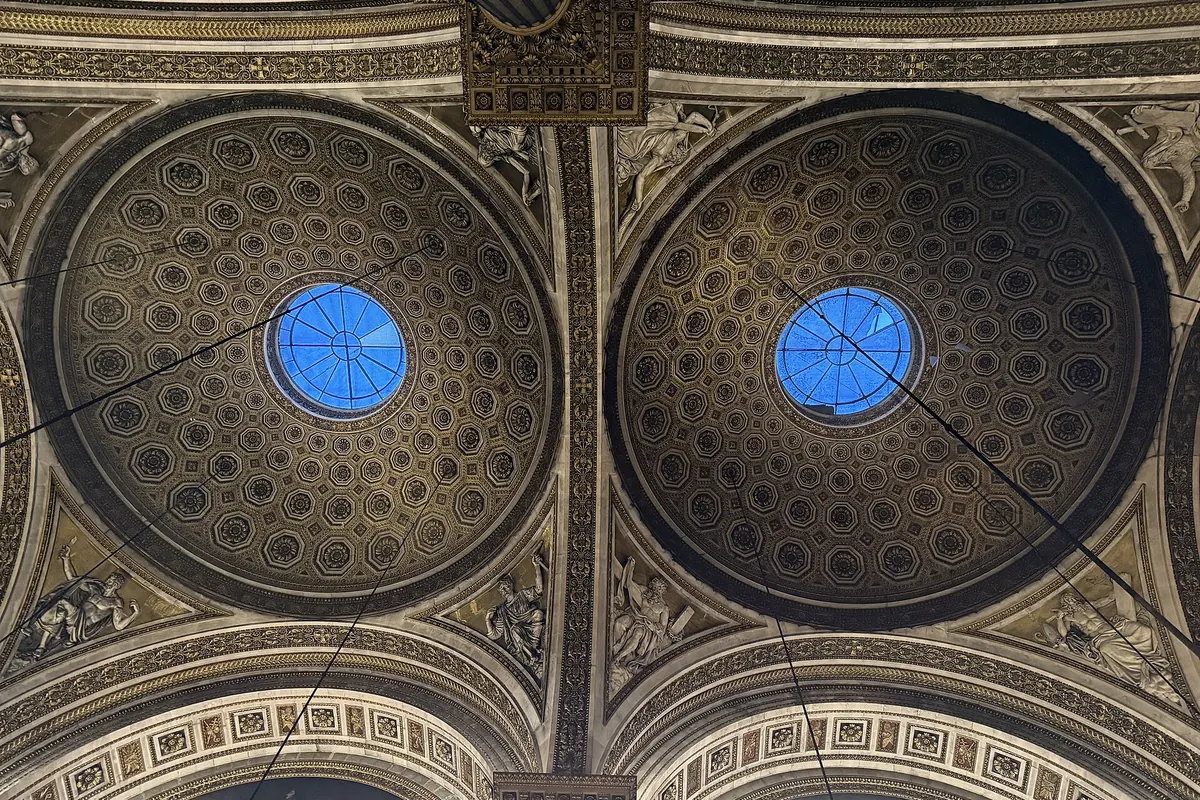
Inside, Wikipedia describes a single long space with no transept, divided into three wide arched bays, each with a dome and circular skylights. The walls, arches and ceiling are decorated with coloured marble and often gilded. A large, domed room with hard surfaces is a lively place for sound, and a concert in the nave suits slow, sustained strings.
The organs
Wikipedia says the main organ was built by Aristide Cavaillé-Coll in 1845 and stands in the tribune over the south entrance, with a smaller choir organ behind the altar. It names Camille Saint-Saëns as titular organist from 1858 to 1877, and Gabriel Fauré from 1896 to 1905. Whether an organ is used depends on the programme, and the booking page does not say.
Fauré and the Requiem
Wikipedia's article on Fauré's Requiem says its first version was performed at La Madeleine on 16 January 1888, for a funeral. If your date at La Madeleine includes the work, the link is a nice one. The booking page lists Fauré's Requiem among its programmes, but only on certain dates, and the calendar will show whether yours is one of them.
On the night itself
The booking page gives no seating plan and no start time in its description; the calendar and your confirmation do. Start times vary by church, so read yours. Plan to arrive about 30 minutes early, and leave food and drink at home. The building is a working church, so modest clothing is the polite choice, and a layer is wise in a large stone interior.
Who this isn't for
Anyone after the closeness of a small medieval church may find La Madeleine's scale may feel grander than cosy. If you dislike neoclassical interiors, the other two churches offer a different mood. And if you want to choose, remember that the calendar assigns the church by date, so you cannot ask for this one on a given night.
Read next: Are the classical concerts in Paris churches worth it?
Frequently asked questions
Why does La Madeleine look like a temple?
It was designed in the Neoclassical manner after a Greek temple, with Corinthian columns on every side.
When did it open as a church?
It was inaugurated as a church on 24 July 1842, after work that began in 1763.
Sources